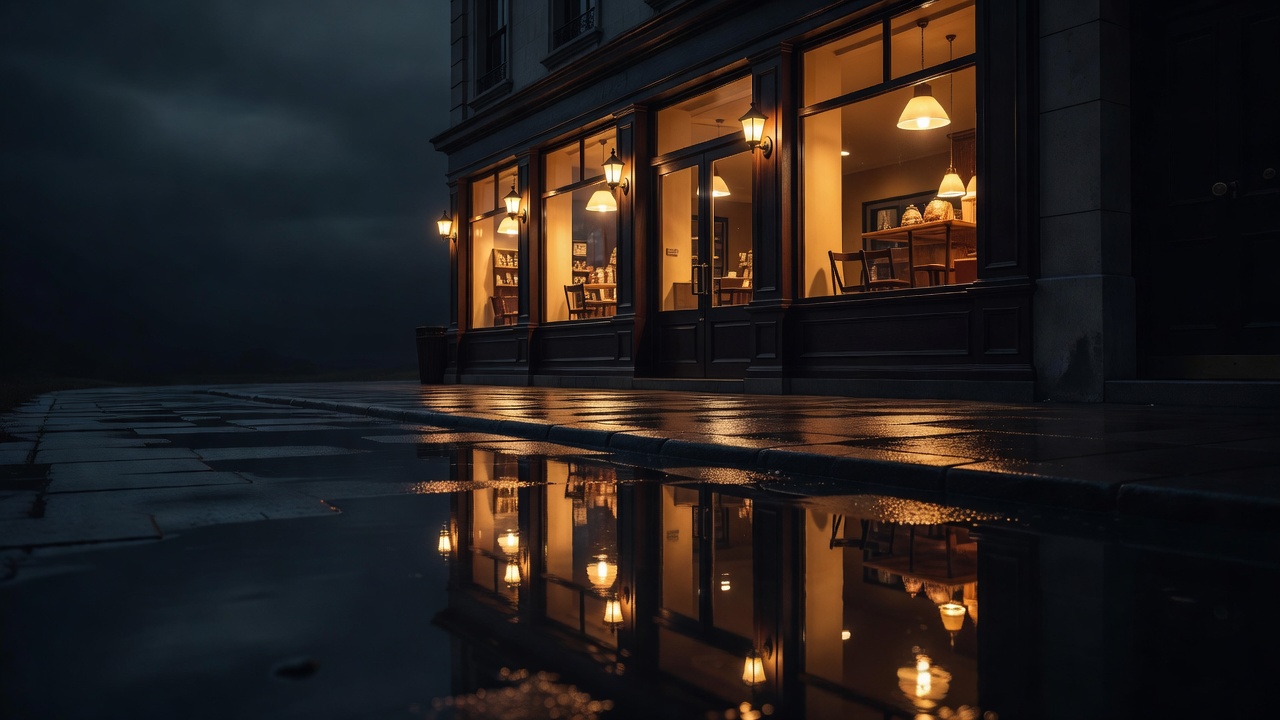
Find a scene with a useful light source
Start with a shop window, a sheltered café entrance or a lamp lighting a small patch of pavement. A scene with a clear source of light is easier to photograph than an evenly dark space. Watch how that light describes the subject. A face near a window may be readable while the street behind it falls naturally into shadow.
You can practice the same idea in familiar places: a residential street, London’s South Bank, a café in Lisbon or an evening market in Taipei. These are location examples, not claims about the photographs shown here. Choose a safe public position, respect private property and keep enough attention on your surroundings to move out of the way.
Separate camera movement from subject movement
A still building and a walking friend need different solutions. Supporting the phone helps both, but it does not stop the friend moving during the exposure. If the architecture looks crisp while a person smears across it, the camera may have recorded exactly what happened over too long a capture period.
For a stationary scene, brace the phone against a stable support without covering its lenses. A small tripod can help, but a secure wall or table may be enough. For people, look for brighter light, ask for a brief natural pause and compare ordinary Photo mode with Night mode. A less aggressively brightened image can be the more useful result.
Let night mode finish its work
Many night modes align and merge several frames to reduce noise and build detail. Some also adjust the capture according to detected movement or whether the phone appears supported. Apple’s Night mode, Google’s Night Sight and Samsung’s Night mode are related ideas, not identical implementations. Availability, timing controls and behavior vary by model and software version.
If the interface shows a countdown, hold your framing until it ends. Do not assume that the first shutter animation means capture is complete. Make one version with the suggested setting and another with a shorter duration if your app permits it. Check both for moving branches, doubled outlines and oddly smooth textures.
Setting note: should I always choose the longest capture?
No. A longer capture can help a still scene, but it gives people, leaves and vehicles more time to move. Use the shortest duration that produces an acceptable result for your subject.
Protect signs and pools of light
A phone may raise the whole scene until the sky looks gray and illuminated lettering loses its shape. Try a modest negative exposure adjustment before capture if your mode supports it. Watch an important bright area rather than judging only the overall preview. A little darkness can preserve the scene’s hierarchy.
Computational processing may change the final brightness after the shutter tap, so inspect the saved file. If a sign remains unreadable, simplify the framing or photograph from a position where it fills more of the image. There may be more contrast than the device can retain in one convincing picture. Accepting a dark corner is often preferable to making every surface equally visible.
Keep the feeling of the light you found, not the brightness the preview suggests.
Watch for flare, reflections and mixed color
A greasy lens cover can turn a lamp into a large haze. Clean it first. If you still see a bright streak or ghost reflection, change your angle slightly and check whether the artifact moves. Do not point at intense lasers, and do not assume a lens protector will be optically invisible at night.
Street lighting mixes different colors. A warm window beside a greenish streetlamp may never look neutral everywhere at once. Set your priority: a believable face, a warm interior or the mood of the street. In editing, adjust white balance gently rather than stripping all color differences from the scene.
Make a short comparison, then stop
Choose one fixed composition and make three photographs: ordinary Photo mode, the suggested night capture and a slightly darker version where controls allow it. Compare important edges, skin texture and the color around bright lights. Do not judge by brightness alone. The cleanest shadow may come at the cost of an unnatural face or a softened moving subject.
Flash is not automatically wrong, but a small phone flash changes nearby light and does little for a distant street. Use it deliberately for a close subject if that look suits your purpose. Otherwise, seek available light and let the background remain atmospheric.